
The first identification of a turnover in the initial mass function within a stellar population, NGC 2024. See link for NASA Press Release.
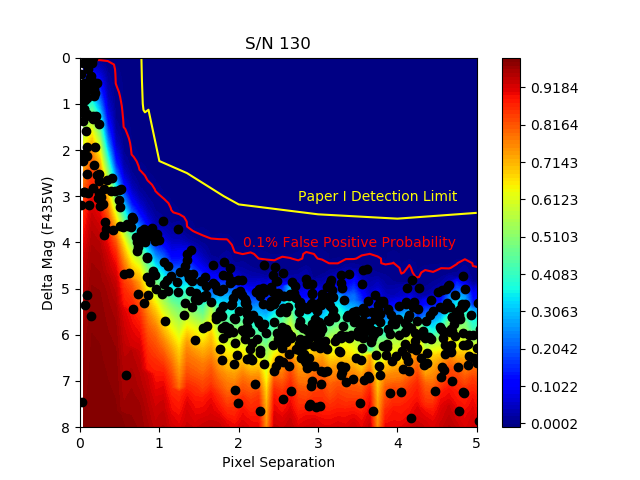
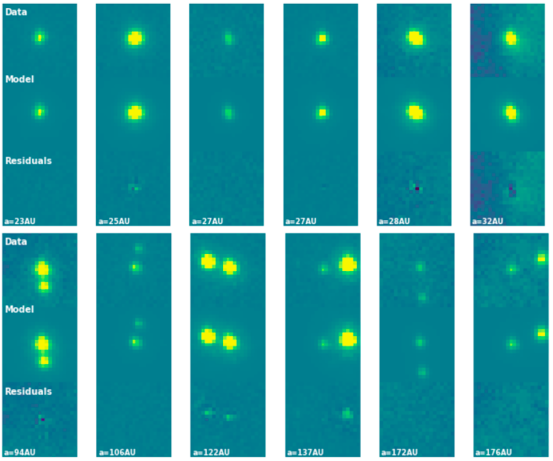
Space-based, diffraction limited, wide-field imaging allows for the efficient characterization of multiplicity within a dense stellar population. With Hubble Space Telescope (HST) data, I developed a double point-spread function (PSF) fitting algorithm that utilizes empirically derived PSF models and exhibited its sensitivity to companions at sub-pixel and sub-diffraction limit scales on the Advanced Camera for Surveys (ACS). With HST/ACS mosaics in the Orion Nebula Cluster (a high-mass, high density star-forming region), I identified dozens of companions (see Fig. 2) to low-mass stars (0.1-0.4 solar masses) down to 10 au in separation, see Fig. 1. With my Bayesian demographic analysis, I showed that the companion population to low-mass stars in the ONC is consistent with the Galactic field population, as is the mass ratio distribution. While companions in Taurus (a low density star-forming region) may be more frequent than the field, my results demonstrate that dynamics in high density regions may sculpt the companion population, disrupting only the widest most weakly bound companions during states of very high density. Further information can be found in two ApJ publications, here and here.
I was awarded an HST Cycle 30 program (GO 17141, PI: De Furio) to explore multiplicity down to 10 Jupiter masses for separations > 0.5λ/D, ~7 au, in NGC 1333, an intermediate density star-forming region with no high mass stars.
To fully understand the impact of star-forming environment (e.g. stellar density and photoionizing radiation) on the formation and evolution of multiple systems, we must explore more common and diverse regions. Large OB associations are present day low density, but may have emerged from more dense embedded clusters that dissipate. If so, they would have the imprint of high density dynamics on the stellar multiple population. If they formed in situ, then dynamical interactions would be very rare, and the companion population would resemble that of low density regions like Taurus. OB associations are large angular sized regions and cannot be efficiently probed with wide-field imaging. However, some Gaia metrics (e.g. the residual unit weight error, RUWE) closely track the presence of a binary companion. This value can be inflated if the single star astrometric solution has large errors due to the presence of another point source in the image. Therefore, if we pre-select a sample with Gaia, we can efficiently probe companion populations over ~ 0.02-1", only observing ~ 20% of the stellar population. I was awarded two night on Keck/NIRC2 and 33 hours on Gemini/Zorro/'Alopeke to observe the likely binary systems, confirm their multiplicity, and estimate the companion parameters, e.g. mass ratio and separation. To date, I have observe 60 sources with Keck imaging and non-redundant masking and 72 sources with Gemini speckle interferometry for a total sample size near 600. This work is not yet finalized, but we have found over 60 new companions, and preliminarily find that the solar-type stars in Orion OB1a, Orion OB1b, the ONC, and the Galactic field all have consistent companion frequencies over 18-480 au and mass ratios 0.2-1. See this link for a presentation at the University of Arizona Origins Seminar that presents the preliminary results.
A-type stars (masses ~ 1.5-3 solar masses) are notoriously difficult to probe for companions through the radial velocity technique, as their absorption lines are broad due to fast rotation. Therefore, our understanding of the multiplicity of A-type primary stars is incomplete below ~ 30 au. Over fourteen nights at the Center for High Angular Resolution Astronomy (CHARA) Array, I observed dozens of A-type stars within 80 pc to look for close companions down to 0.5 milli-arcseconds using longbaseline interferometry with the MIRC-X and MYSTIC instruments. In two papers, here and here , I identified seven companions to a sample of 54 stars, and show that A-type stars likely have a lower companion frequency than B-type stars over separations of 0.01-27.54 au and mass ratios 0.1-1. This is potentially indicative of enhanced disk fragmentation with higher mass. My survey is ongoing with a larger sample observed in 2025 still being analyzed for tighter constraints on the companion population.
The first identification of a turnover in the initial mass function within a stellar population, NGC 2024. See link for NASA Press Release.
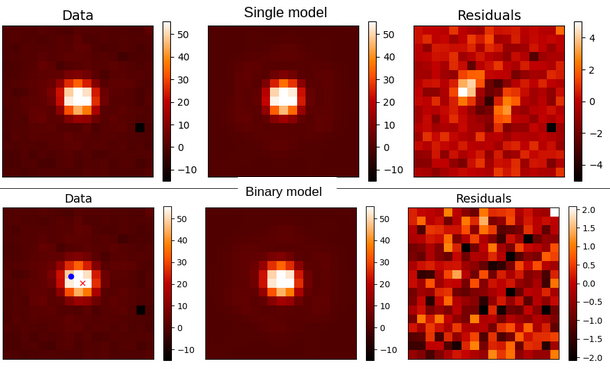
Detection of the second Y-Y dwarf binary system ever, WISE1935-1546, using JWST/MIRI probing the lowest mass binaries in the Galaxy. See link for paper.
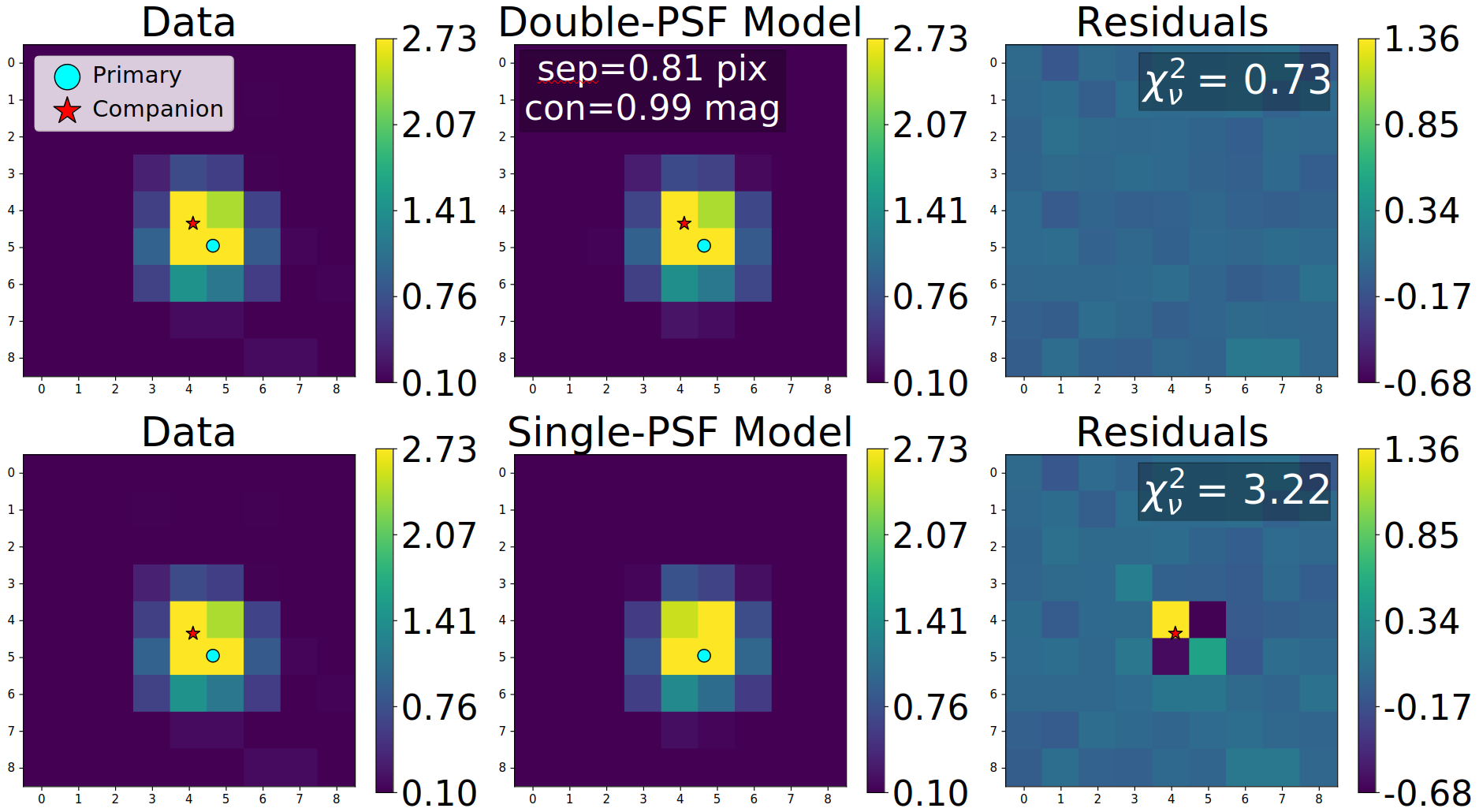
Resolving companions below the diffraction limit with HST WFC3/IR. See link for paper.
For inquiries about collaborations, details about my research and outreach, or general questions, please reach out to me through email.