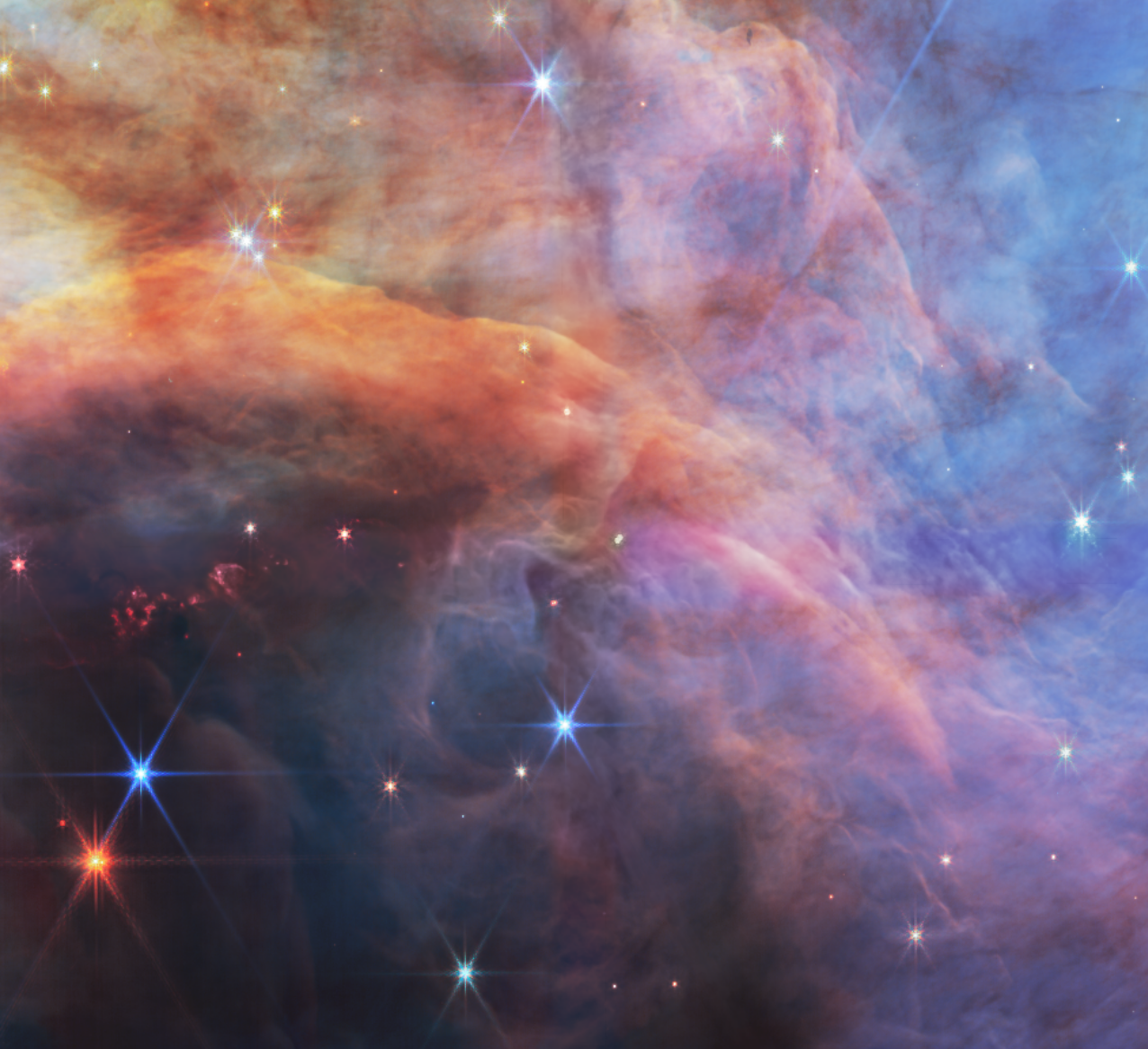
The first identification of a turnover in the initial mass function within a stellar population, NGC 2024. See link for NASA Press Release.
I am originally from Tampa, Florida, and graduated from the University of Florida in 2016 with a B.S. in Physics and Astronomy and a minor in Mathematics. While at UF, I first started astronomy research with Elizabeth Lada characterizing the circumstellar disk population of low-mass stars and brown dwarfs in nearby young star-forming regions. Although I now exclusively study astrophysics, at UF I also worked in the biophysics lab of Stephen Hagen where I explored the effects of oxidative stress on the genetic competence network of a type of bacteria that causes cavities, Streptococcus mutans, and my results are published in the journal of Applied and Environmental Microbiology.
I then traded the swamps of Gainesville for the snow covered trees of Ann Arbor and received my PhD in Astronomy and Astrophysics at the University of Michigan in 2023 where I worked with Michael Meyer. As a graduate student, I probed the low-mass stellar and sub-stellar binary populations of the Orion Nebula Cluster, using the Hubble Space Telescope, demonstrating the importance of cluster dynamics in sculpting the companion population. In this work, I developed and implemented a double PSF-fitting algorithm using empirical models capable of detecting companions at sub-diffraction limit scales on HST/ACS. This work led to a Cycle 30 HST program that I lead to perform a multiplicity survey down to 10 Jupiter masses in NGC 1333. Since then, I have adapted this technique to resolve companions on sub-diffraction limits scales on WFPC2/PC, WFC3/IR, WFC3/UVIS on HST and NIRCam, NIRISS, and MIRI on JWST.
At UM, I led a long-baseline interferometry survey of nearby A-type stars in the Galactic field using the CHARA Array to probe the close companion population down to 0.01 au. I showed the likely increase in close companions with primary mass, suggesting enhanced disk fragmentation for masses > 3 Msun. This survey is ongoing with the goal of a volume-complete sample and so far has been awarded 14 nights at CHARA. At the end of my PhD, I joined the JWST NIRCam and NIRISS science teams, focusing on free floating planetary mass objects in star-forming regions and field brown dwarfs.
Since 2023, I have been working as an NSF Astronomy and Astrophysics Postdocotral Fellowship at the University of Texas at Austin. My NSF fellowship research program is focused on describing the companion populations of stars in a variety of star-forming environments to fully characterize the impact of cluster dynamics on the formation and evolution of multiple systems. For this project, I am working with Gaia, Keck, and Gemini on the solar-type populations of star-forming regions that have experienced very different environmental histories. This work is ongoing with the expectation of the survey paper completed in 2026.
While an NSF fellow, I was the first to identify a turnover in the initial mass function of a stellar population. I defined the mass function in NGC 2024, a young star-forming region, as a broken power law increasing in linear space from the sub-stellar limit to ~ 10 Jupiter masses, then decreasing down to the sensitivity limit of my survey, 0.5 Jupiter masses. The lowest mass object detected has an estimated mass of 3 Jupiter masses, potentially the fundamnetal limit of the fragmentation process. This work led to a JWST Cycle 3 program that I PI to obtain NIRSpec prism spectra of these free floating planetary mass objects and parallel NIRCam imaging in the outskirts of the star-forming region to probe intra-cluster environmental differences.
I have continued my exploration of the brown dwarf binary popualation as a part of several collaborations. We have discovered the only two known Y-dwarf binary systems with JWST using my empirical PSF-fitting code, WISE0336 and WISE1935, and ruled out a companion to the suspected binary Y-dwarf WISE1828 at separations > 0.5 au. This work led to a Cycle 31 HST program that I co-PI to perform the largest brown dwarf multiplicity survey to date, mining the HST archive, and using my empirical PSF-fitting code.
I also work on novel high contrast imaging techniques, using measured wavefront sensing information from JWST and synthetic PSF models, to directly imaging planetary mass companions at diffraction-limited scales without the use of a calibrator star. This work led to a Cycle 4 JWST archival program that I co-PI where we are applying this technique to a variety of observed data sets to demonstrate the utility of this approach.
The first identification of a turnover in the initial mass function within a stellar population, NGC 2024. See link for NASA Press Release.
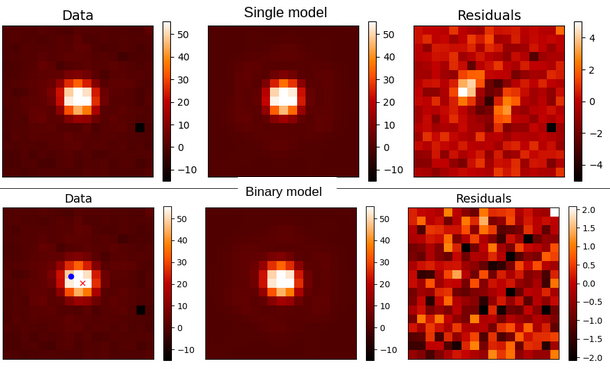
Detection of the second Y-Y dwarf binary system ever, WISE1935-1546, using JWST/MIRI probing the lowest mass binaries in the Galaxy. See link for paper.
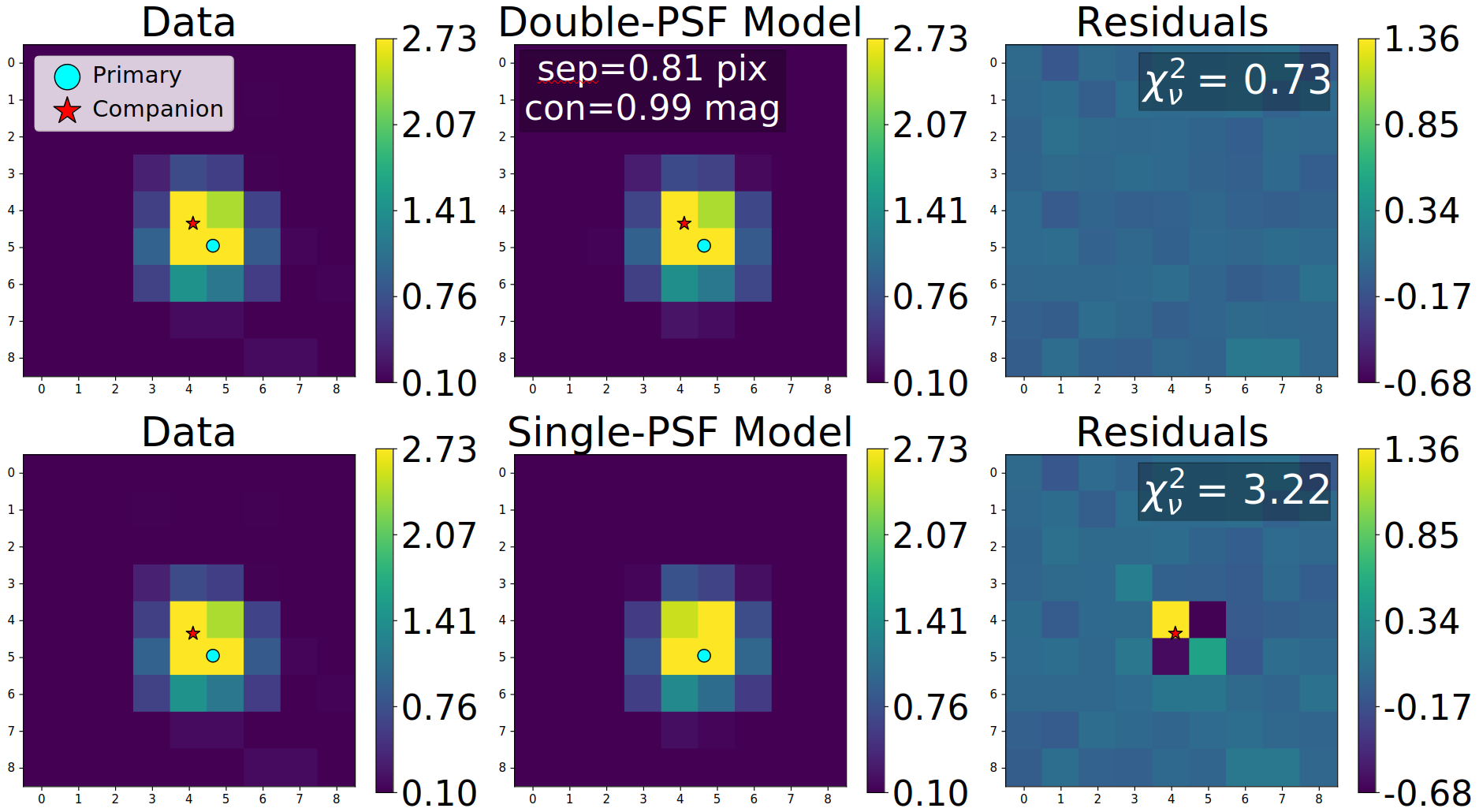
Resolving companions below the diffraction limit with HST WFC3/IR. See link for paper.
For inquiries about collaborations, details about my research and outreach, or general questions, please reach out to me through email.